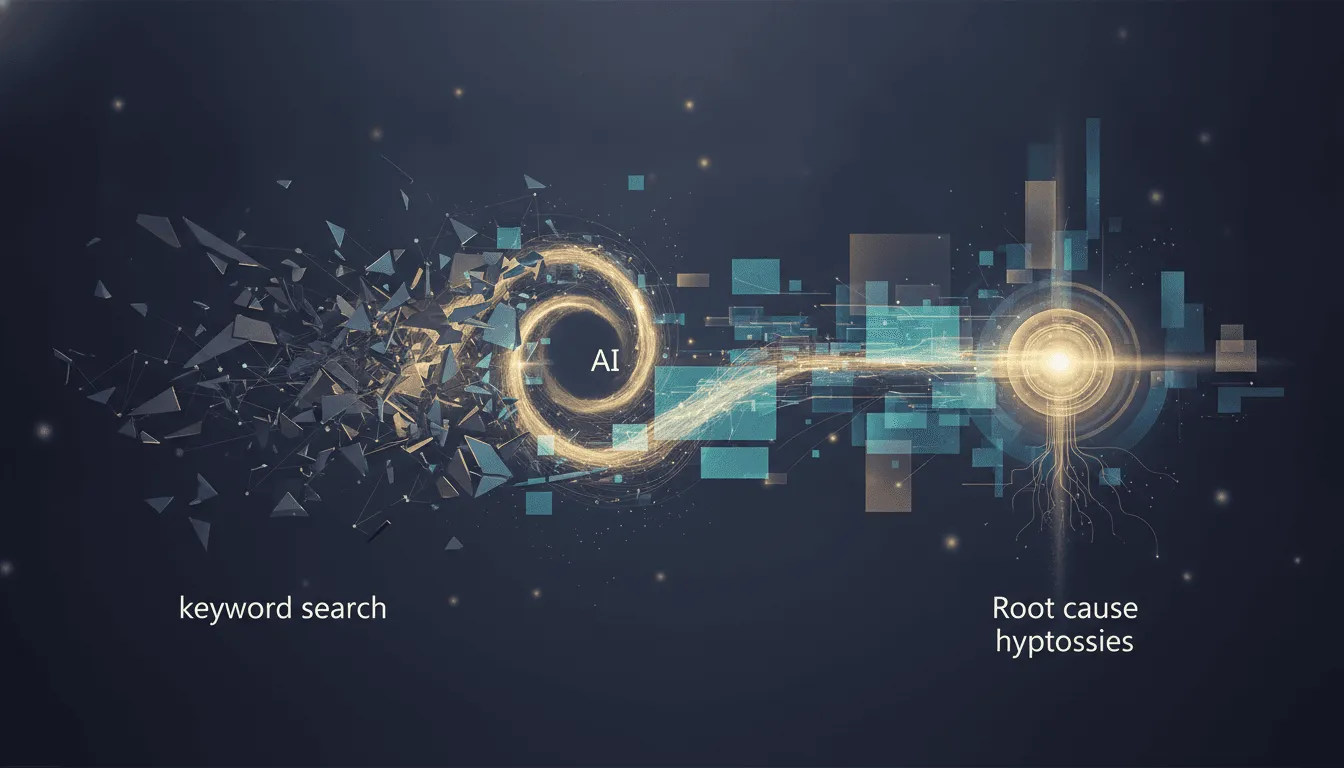
AI log analysis is an assistive layer on top of existing log management workflows, not a replacement for search. Traditional analysis depends on fixed rules and human-directed keyword or regex queries, which work well when the failure mode is already known. AI-assisted analysis is pattern-driven and adaptive. Log anomaly detection is the underlying mechanism. The model learns each service's typical request rates, error counts, and latency distributions, then flags deviations from those baselines. Those deviations often indicate the start of a failure.
The practical contribution is generating root-cause hypotheses by correlating patterns. An AI tool can summarize a cluster of PaymentService timeouts followed by a database connection-pool warning and suggest the two are likely related. Automated cross-service correlation identifies likely causal chains without manual timestamp matching, reducing investigation time.
Keyword search does not disappear inside advanced AI pipelines. A multi-agent RAG system for log analysis combines BM25 lexical matching with semantic embeddings. The BM25 matcher catches exact terms, while the semantic embeddings retrieve logs that are conceptually similar even if they use different wording. The system then reranks the results, grades them for relevance, and generates a context-aware answer. A self-correction loop rewrites queries and retries. The design mirrors the loop engineering pattern used in other LLM agent systems: act, evaluate, retry.
A regex query finds the lines you already suspect. AI correlation finds the lines you did not know to look for, and it groups them into a likely causal chain.
LLMs distill stack traces and error contexts into manageable summaries that guide debugging. These summaries are hypotheses, not confirmed diagnoses. General-purpose LLMs do not naturally produce expert reasoning workflows, so frameworks such as LogReasoner add coarse-to-fine reasoning stages. The coarse stage identifies broad error categories, and the fine stage narrows to specific root causes, mimicking how an engineer triages an incident. A coarse-to-fine approach might first narrow the error to a subsystem, then to a specific resource.
Always cross-check AI-generated correlations against actual log timestamps and trace IDs before acting. Trace IDs link log lines across services into a single request path, making it possible to verify whether a suggested correlation is real. Verification is not optional; a wrong hypothesis can send you down a rabbit hole. For example, if the AI suggests a connection between a timeout and a pool warning, check the trace ID on both log lines to see if they share the same request path. The hypothesis narrows the search; the trace confirms it.
Integration is additive. Put the AI as an API layer on top of existing observability tools like Loki or ELK, and avoid a rip-and-replace of the current stack. The API layer keeps the existing stack intact while adding a reasoning layer on top, which fits the pattern of pragmatic AI workflow augmentation rather than wholesale replacement. It works best when the LLM has access to the structured context that trace IDs provide.
Set up feedback loops where engineers mark each suggestion as correct, incorrect, or partially correct to improve future suggestions. For example, marking a false correlation as incorrect teaches the model to avoid that pattern in future suggestions. Model drift, bias, and incorrect conclusions require validation before operational changes. Each correction teaches the model which correlations matter in your environment, grounding future suggestions in your team's actual patterns rather than generic training data. Without these loops, suggestions become less relevant as your systems evolve.
Organizations commonly report 30–60% MTTR reductions, halved investigation times, and up to 25% lower log storage costs when AI is used as a hypothesis generator, not an autopilot, and those gains depend on treating AI outputs as likely causal chains to investigate, not final answers.
The operational risk is not that AI will be wrong; it is that a wrong suggestion will look plausible enough to act on without verification.