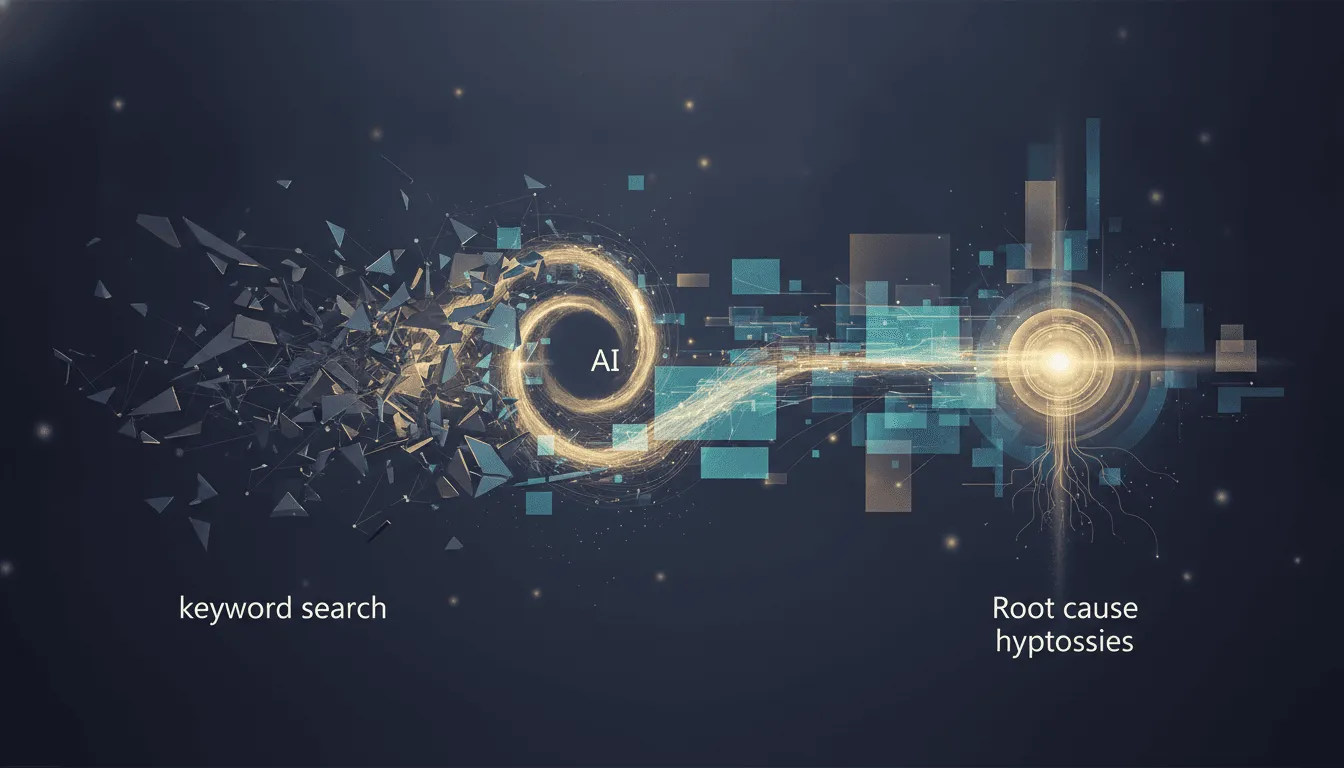
Chaos engineering is the intentional, controlled injection of failures to expose weaknesses before they reach customers. Netflix built Chaos Monkey to create incidents in IT services, but the goal is to identify vulnerabilities and inform automatic recovery. Harness's platform cuts chaos experiment creation from two hours to fifteen minutes. Harness combines a chatbot with visual building blocks that help engineers discover failure modes, visualize blast radius, and construct experiments. The Harness MCP integration brings similar capabilities into AI-powered code editors through natural language, letting DevOps, QA, and SRE teams discover, run, and analyze experiments without deep vendor-specific knowledge. AWS describes an AI-powered resilience framework that discovers infrastructure dependencies in hours and generates targeted experiments. That speed addresses the expertise gap most teams face: designing meaningful chaos experiments typically requires specialized knowledge of distributed systems and failure modes. Uber integrated an LLM-based mobile testing platform with a service-level fault injection system, executing over 180,000 automated chaos tests across 47 critical flows in Rider, Driver, and Eats. The testing identified 23 resilience risks, with 70% being architectural dependency violations where non-critical service failures degraded core user flows. Twelve issues were severe enough to prevent trip requests or food orders. Traditional chaos engineering relies on manual scenario selection and lacks automated analysis. AI changes both constraints. The speed gain resembles what AI brings to unit test generation: faster creation, but human review still decides what ships.
AI does not remove the need for human judgment about what to break. Chaos engineering does not aim to break everything; it targets specific failure scenarios that matter to the business. The Uber findings show why: non-critical services degraded core flows, so teams must decide which services are actually critical. A service that handles internal logging might seem low priority, but if a core flow depends on it, breaking it degrades the customer experience. The dependency graph shows which services are load-bearing, but it does not show which failures matter most to users. Business impact is not always obvious from the graph alone; a service's criticality depends on its position in the dependency graph, not its function alone. That decision requires understanding the user journey, not just the service topology. The user journey is the ultimate test of what matters. This mirrors the broader pattern of pragmatic AI adoption.
Run experiments in controlled environments with blast radius limits. Use feature flags and circuit breakers to contain impact. Maintain a human-approved experiment schedule so AI suggestions go through review before execution. Always have a rollback plan that can restore service in minutes. A rollback plan should be tested before the experiment, not after. Blast radius limits might restrict a failure to a single instance or a small percentage of requests. These guardrails matter because chaos engineering injects real failures. The experiment itself must not become the incident. The schedule can be a simple checklist that requires a named engineer to approve each experiment before it runs. The checklist might also include a rollback trigger and a communication plan. Teams should start with small experiments to build confidence before scaling up.
AI can generate targeted experiments from discovered dependencies, but outcomes still need validation against real telemetry. A simulation that predicts a five-second latency spike might produce a thirty-second outage in practice. Only real-world validation reveals the gap. Validation also catches false confidence: an AI model trained on historical incident data may not account for new services or changed traffic patterns. Real experiments generate fresh data. For a latency spike, the team would measure the actual p99 under failure and compare it to the prediction. Teams can set up a simple spreadsheet to log predicted and actual metrics for each experiment. Comparing predictions with outcomes turns AI into a learning system; without that feedback, suggestions drift from reality as systems evolve.