From Alert Fatigue to Pre-Incident Signatures
Modern on-call rotations receive more telemetry than any human can process. Alert fatigue sets in, and decision-making slows. AIOps platforms address this by unifying data streams and applying machine learning to correlate events, suppress noise, and surface actionable indicators.
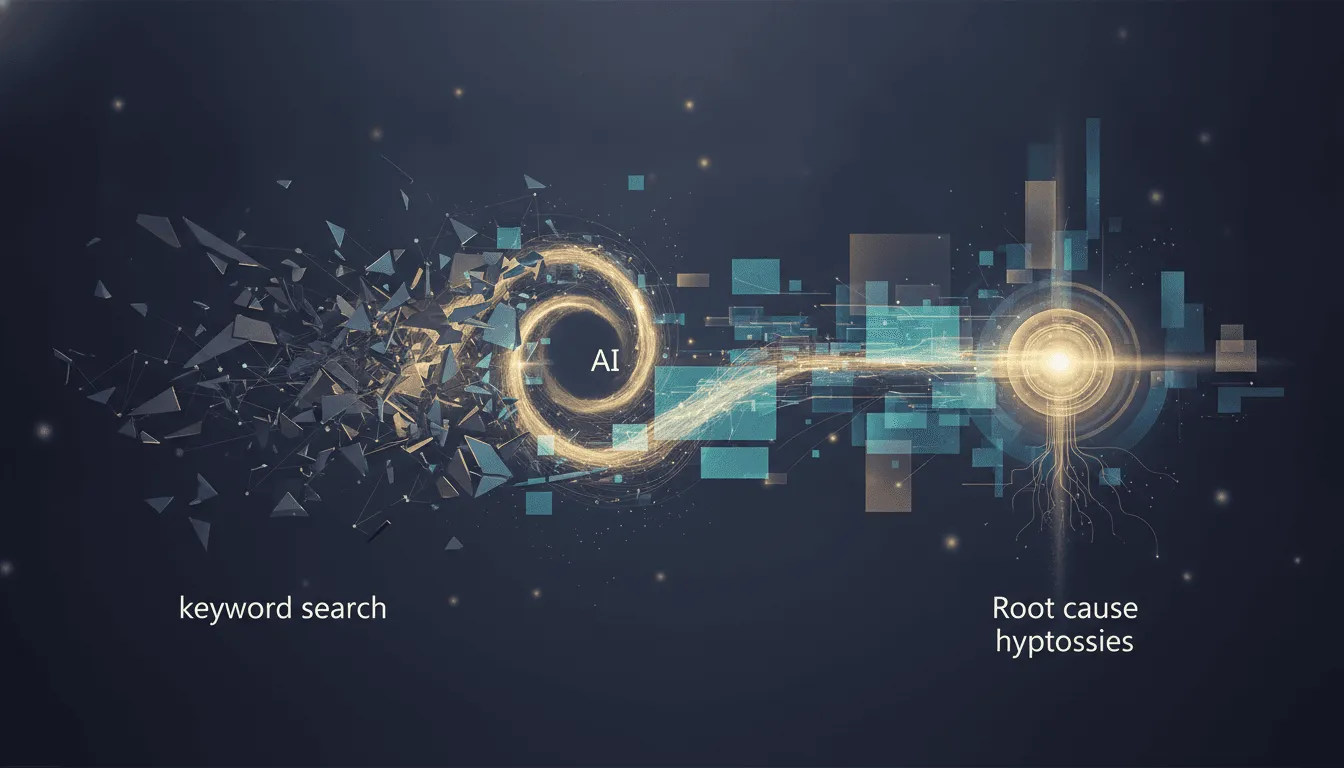
Prediction goes one step further. AI incident prediction analyzes historical incident data, log patterns, and deployment history to forecast likely failure windows. The workload is probabilistic, not deterministic. The goal is to reduce uncertainty and focus human attention on the highest-risk changes and timeframes. Anomaly detection on metrics and logs surfaces pre-incident signatures. Gradual latency creep, error-rate drift, or correlated anomalies across components often precede a full incident. Grafana Labs' acquisition of Asserts.ai added contextual observability that surfaces relationships among system components for faster root cause analysis, rather than relying on isolated threshold breaches.
Meta's Diff Risk Score (DRS) predicts the risk of code changes at the diff or PR stage, informing merge and gating decisions before release.
A Concrete Setup: Metrics, Logs, and a Calibration Loop
A practical implementation starts with data. Feed Prometheus metrics and PagerDuty history into a lightweight ML model or LLM-based system to generate risk scores for upcoming shifts. The model learns which metric patterns preceded past incidents and scores each shift accordingly.
Calibration matters more than accuracy. Tune thresholds to your team's tolerance for false pages versus missed incidents, with a payments service needing higher precision than a low-traffic internal tool. The risk score output feeds a dashboard or a notification that tells the on-call engineer where to focus. The data pipeline should include a feedback loop: after each incident, the model's prediction is compared with the outcome, and the training data is updated.
Pair every AI prediction with human review. LLM-suggested actions carry hallucination risk, especially for destructive operations. A responder must verify any suggested remediation before execution.
Governance boundaries keep AI agents in scope. AI handles bounded detection, triage, and enrichment within defined limits. Autonomous remediation stays out of reach. The same historical data that predicts failure windows also powers triage during active incidents, where AI deduplicates alerts, scores priority, and enriches incidents with runbooks and similar past incidents. incident.io's Investigations feature automates up to 80% of incident response, covering triage and investigation rather than autonomous remediation. This mirrors the shift toward AI co-pilots in other engineering domains, where bounded assistance replaces full autonomy.
Turning Predictions into Preparedness
Predictions only help if they change what you do before the page arrives. Pre-write runbooks for the most likely incident types the model identifies.
Run targeted load tests or chaos experiments during predicted high-risk windows. This validates system resilience when the model expects trouble. If the system handles the injected load, the prediction window passes with evidence. Chaos experiments during a predicted window also test the runbook's accuracy. For example, if the model flags a high-risk window for a database service, the team can run a read-heavy load test to see if the database handles the spike.
Review predictions in a team standup. Align on priorities, adjust thresholds based on feedback, and document what the model got right or wrong. The calibration loop closes with human judgment.
Predictions also inform capacity planning. A high-risk window for a specific service tells the team to check headroom, verify backups, and confirm failover paths before the window opens.
Pitfalls: Overfitting, Novel Failures, and Complacency
Prediction models overfit to historical incidents. They miss novel failure modes that do not match past patterns. A model trained on last year's outages cannot anticipate a new class of failure introduced by a new dependency or architecture change.
Prediction narrows the range of possible outcomes; it does not pin down a single one. Teams that treat model output as certainty lose the benefit of the tool.
Complacency is the quiet risk. When predictions are reliable, responders stop questioning them. Regularly review the model's predictions against actual incidents to catch drift.
AI's value depends on treating it as normal technology, a grounded tool that augments rather than replaces human judgment.