The Coriolis effect is the apparent deflection of objects not firmly connected to the ground as they travel long distances around Earth. It is not a real force. It comes from Earth's rotation, which moves faster at the Equator than at the poles. Equatorial regions travel nearly 1,600 kilometers per hour, while near-polar regions move only about 0.00008 kilometers per hour.
In the Northern Hemisphere, moving objects appear to deflect to the right. In the Southern Hemisphere, they appear to deflect to the left. The effect is strongest at high speeds or over long distances. A plane flying north from the Equator keeps the faster eastward speed it had at takeoff. The ground beneath turns more slowly, so the plane appears to curve eastward. No force pushes it sideways; the curve is an illusion created by the rotating reference frame.
That apparent bend is the whole phenomenon. The observer on the rotating ground sees a curve that an observer in space would not. Scale separates a noticeable deflection from an invisible one. Over a few meters, Earth's rotation is too slow to matter. Over a thousand kilometers, it bends storm systems and ocean currents. The deflection applies to anything moving across the surface: wind, ocean water, and aircraft. Each follows a curved path as seen from the ground, even though each moves in a straight line through space. At the Equator, the effect is zero because the ground and the object share the same eastward speed. The deflection grows with latitude, where the ground's speed decreases. The magnitude of the deflection depends on the speed of the object and the sine of the latitude. A baseball thrown across a field will not curve noticeably. Even a fast pitch travels only a few dozen meters, far too short for Earth's rotation to matter.
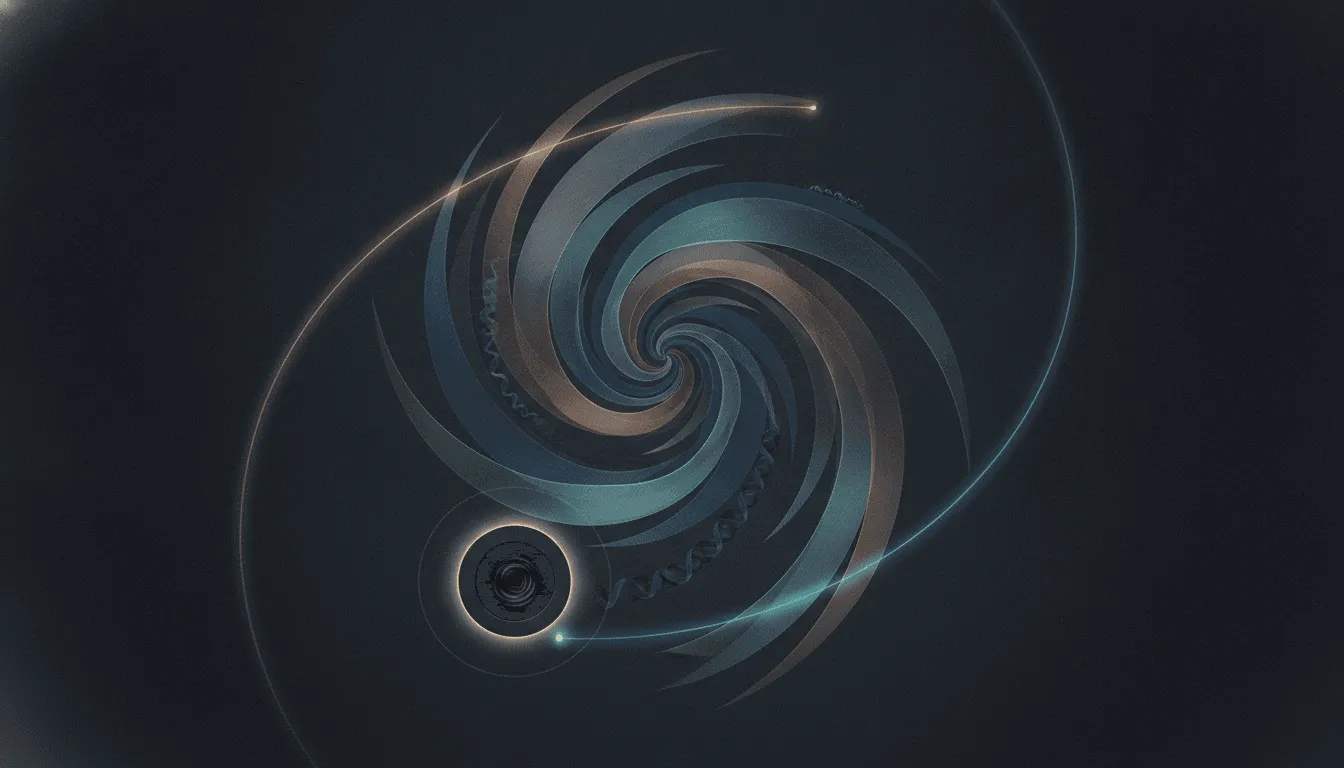
Cyclones are low-pressure systems that pull air into their center, or eye. As air rushes inward, the Coriolis deflection bends it. In the Northern Hemisphere, air masses deflect to the right as they are pulled in, so storm systems such as hurricanes rotate counterclockwise. In the Southern Hemisphere, currents deflect to the left, so storms rotate clockwise. The eye is the calm center of the storm, surrounded by the rotating wall of clouds. The Coriolis effect organizes that rotation into a coherent spiral rather than a chaotic inflow. Without the effect, a low-pressure system would simply fill in evenly from all sides.
The same mechanism drives ocean currents. Water moves across thousands of kilometers, long enough for Earth's rotation to bend its path. The result is the large circulating gyres that move heat around the planet, the same conveyor belt that shapes climate. These gyres redistribute warmth from the tropics toward the poles, influencing weather patterns on a global scale. The same deflection that bends hurricanes also drives the trade winds, which blow from the east in the tropics.
The popular idea that the Coriolis effect decides which way water drains in a sink or toilet is a myth. Water does drain clockwise in the Southern Hemisphere, but it also drains counterclockwise there. In fact, it drains whichever way it desires, regardless of geographical locale. The myth was debunked long ago but persists in popular culture.
The reason is that the Coriolis effect operates on a massive scale; over a few centimeters, Earth's rotation is too weak to bend the flow. In a sink, the basin shape and any residual motion in the water dominate, making the Coriolis effect minuscule by comparison. People observe different drain directions, but those differences come from the sink's geometry and how the water was introduced, not from Earth's rotation. A toilet's design forces the water through a siphon, and the initial swirl is set by the bowl's shape, not by the Coriolis effect.