What Drives Ocean Currents?
Every second, the Gulf Stream carries warm water toward Europe, while deep cold currents flow back toward the equator. This exchange is part of a global ocean circulation system that regulates climate. Ocean currents are large-scale movements of seawater, driven by wind, Earth's rotation, and differences in water density. Surface currents are primarily wind-driven, while deep currents are driven by density contrasts set by temperature and salinity—a process central to the thermohaline circulation. Oceanographers use the scientific method—observing, hypothesizing, and testing—to decode these patterns. For example, they deploy CTD profilers to measure temperature and salinity at various depths, revealing the density structure that controls deep-water flow.
Surface Currents: Wind and the Coriolis Effect
Prevailing winds—such as the trade winds and westerlies—push surface water across the oceans. Because Earth rotates, these moving water masses are deflected by the Coriolis effect, curving to the right in the Northern Hemisphere and left in the Southern Hemisphere. This deflection creates large, circular systems called gyres in each ocean basin. These surface currents redistribute heat from the equator toward the poles, moderating global temperatures. Modern satellite observations allow scientists to track these patterns, revealing their influence on weather and climate.
Deep Currents: The Thermohaline Circulation
Below the surface, a slower but immense circulation operates. In polar regions, cold temperatures and high salinity make seawater dense enough to sink. This dense water flows along the ocean floor toward the equator, while warmer, less dense water rises elsewhere, completing a slow global circuit. In the Atlantic, this sinking is known as the Atlantic Meridional Overturning Circulation (AMOC), a crucial component of the global conveyor belt. This density-driven flow plays an essential role in storing and transporting carbon and nutrients.
The Global Conveyor Belt
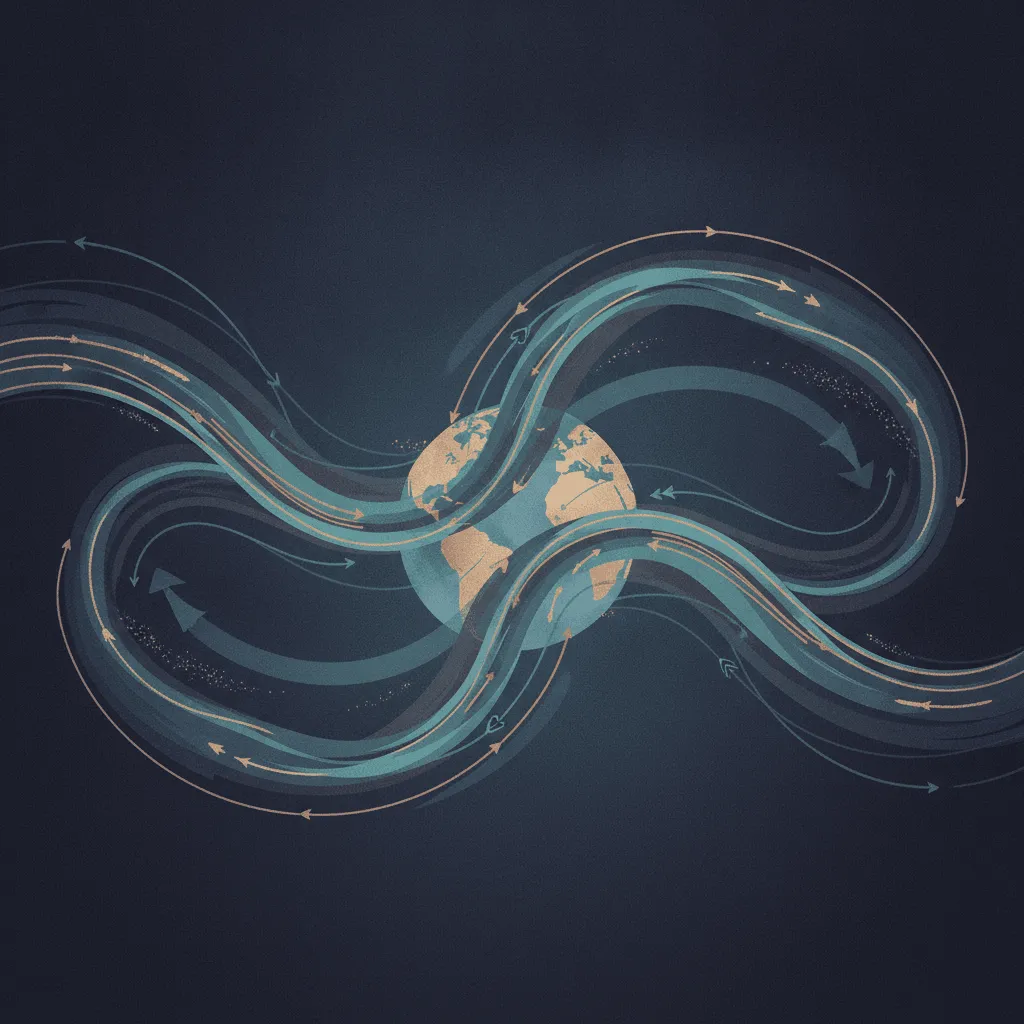
The thermohaline circulation, including the AMOC, is often described as a global ocean conveyor belt because it links surface and deep currents in a single, planet-wide system. This conveyor belt transports not only heat but also carbon and nutrients, influencing climate patterns on very long timescales. The interconnectivity means that changes in one region—such as increased freshwater input from melting ice—can ripple across the entire circulation, potentially altering climate far from the source.
Impacts on Climate and Life
Ocean currents have major influences on regional climates by redistributing heat. They also affect weather phenomena such as El Niño and monsoon systems. If the AMOC weakens, it could lead to cooler temperatures in the North Atlantic region despite global warming, and disrupt sea levels and weather patterns around the world. Where deep water rises to the surface—a process called upwelling—it brings nutrients that support rich marine ecosystems, sustaining fisheries and biodiversity. These nutrient-rich zones demonstrate how currents directly support life, making understanding these patterns essential for predicting ecosystem changes.
Why Understanding Matters
As climate changes, the stability of the ocean conveyor belt becomes an urgent concern. A key component, the Atlantic Meridional Overturning Circulation (AMOC), could weaken due to increased freshwater from melting Greenland ice, potentially causing regional cooling in Europe and sea-level rise along the U.S. East Coast. Monitoring and predicting such shifts is a top priority for climate science. Effective communication of these risks—through IPCC reports, for instance—is vital for policymakers and the public. For those seeking to learn more, accessible resources can help. Bill Gates recommends Weather for Dummies as a starting point for understanding weather and ocean processes. Additionally, the Scientific Evidence Indicator, a tool designed to help readers evaluate the strength of evidence in science news, can aid in assessing reports about ocean circulation. By bridging the gap between research and understanding, these resources empower societies to prepare for the challenges ahead. The ocean conveyor belt is a central axle of our climate system—grasping its workings is not just an academic exercise but a necessity for the future.