The Experiment That Started It All
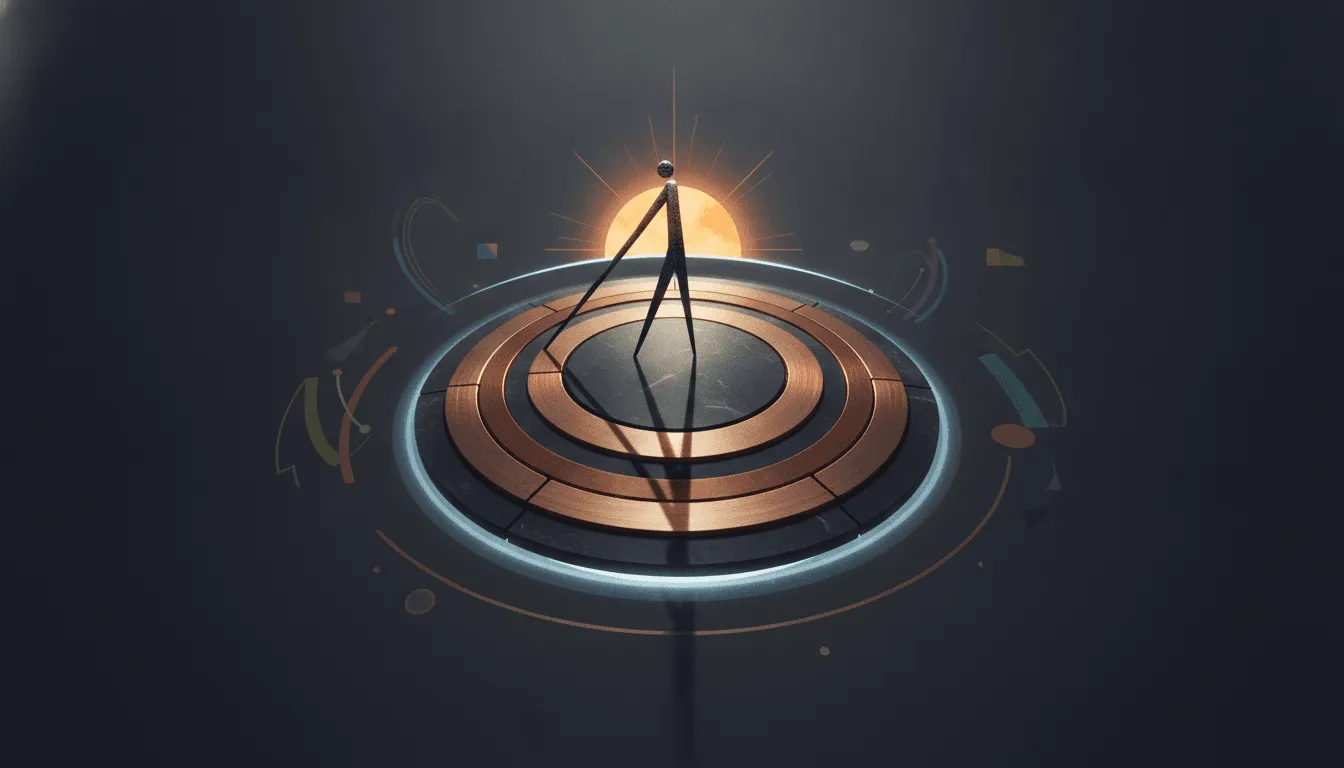
By around 500 B.C., most Greeks believed Earth was round. Around 240 B.C., Eratosthenes, chief librarian of Alexandria, turned that spherical model into a measurement. He learned that at noon on the summer solstice (around June 21), the Sun illuminated the entire bottom of a well in Syene, meaning it was directly overhead. In Alexandria, he used a vertical stick called a gnomon and measured the angle of its shadow at the same time. The angle was about 7.2 degrees, one fiftieth of a circle. The distance between Syene and Alexandria, measured by foot, was 5040 stades, with one stade roughly 160 meters. Assuming the Sun's rays arrived parallel, the shadow angle equaled the angular separation between the cities. He used these numbers to compute a circumference of about 250,000 stades, close to 40,000 kilometers.
Why a Shadow Reveals an Angle
The Sun is so distant that its rays reaching any two points on Earth are effectively parallel. At Syene, the Sun was exactly overhead, so its rays aligned with the vertical direction. In Alexandria, the vertical direction points toward the center of the Earth, so the same parallel rays strike the ground at an angle, casting a shadow from a vertical stick.
To find that angle, measure the shadow length and the stick's height. The tangent of the angle equals shadow length divided by stick height, so the angle is arctan(shadow/height). This angle equals the angular separation between the two locations. Parallel rays create congruent alternate interior angles when they cross the lines from the stick to the Sun, so the measured angle at Alexandria matches the difference in latitude between the cities. At Syene, the angle is zero, so the difference is just the Alexandria angle. The geometry holds regardless of the distance between the locations, as long as both measurements are taken at solar noon on the same date.
The Calculation in Three Steps
You can reproduce Eratosthenes' calculation in three steps. First, two observers at different latitudes measure the Sun's shadow angle at solar noon on the same date; subtract the smaller from the larger to get θ. For Eratosthenes, θ was 7.2° because the Sun was overhead at Syene. Second, find the north-south distance along a meridian, not the crow-flies distance; it was 5040 stades for Eratosthenes, about 800 kilometers. Third, apply the formula: circumference = (360 / θ) × distance. For example, if the angles are 45° and 30°, θ = 15°, and the circumference is 24 × the north-south distance. With θ = 7.2° and distance = 800 km, the ratio 360/7.2 is 50, so 5040 × 50 = 252,000 stades. Eratosthenes reported 250,000 stades, a rounding of that product; the result is about 40,000 kilometers, close to the modern value.
Doing It Yourself: No Travel Required
You need a clear day, a vertical stick, a protractor, a measuring tape, and a way to measure shadow length at solar noon. Solar noon is when the Sun reaches its highest point; the shadow is shortest then. Ensure the stick is vertical using a plumb line or a level. Also pick a spot with an unobstructed view of the Sun at noon. To get two angles, find a partner at a different latitude and both measure at your own local solar noon on the same date. Students have coordinated across countries using social media. The distance to use is the north-south separation between your latitudes, not the overland route. If you lack a partner, you can use a second location with a known latitude where the Sun is directly overhead at that time, such as the Tropic of Cancer on the summer solstice, or look up the Sun's noonday angle for a distant city from an astronomy almanac.