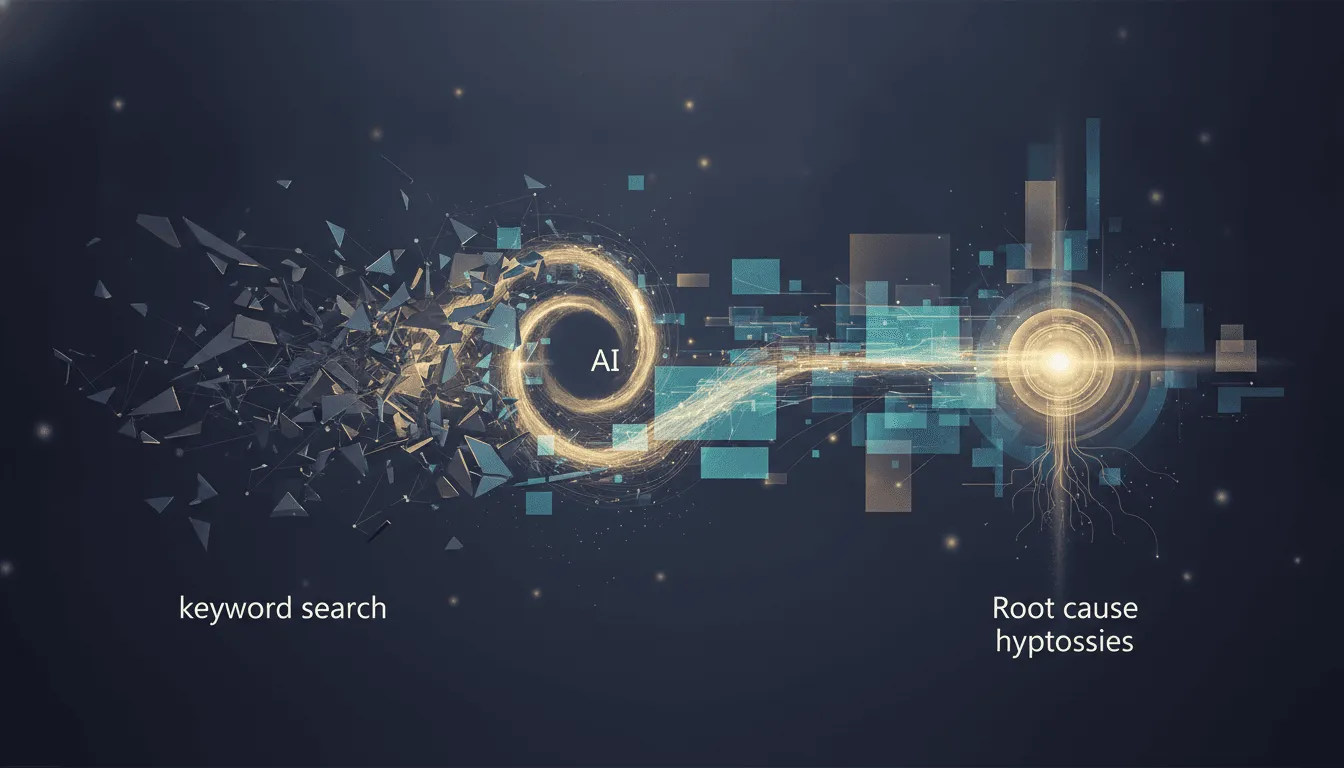
What AI Estimation Actually Computes
An AI estimation tool forecasts by mining historical project data. It finds work similar to the new request, then extrapolates cycle time and throughput from how those past work items behaved. The output is a probability distribution with confidence bands, not a date on the calendar. For AI project planning, the first step is to accept that the tool is not an oracle.
Software estimation already fails without AI. One analysis of software projects puts average cost overruns at 189% and time overruns at 222%. The root cause is not that the future is unknowable. It is that organizations punish honesty about uncertainty and conflate estimates with targets and commitments. Point estimates pretend certainty that does not exist. Story points get gamed when they are used as metrics.
AI cannot solve that cultural problem on its own. What it can do is make uncertainty visible and shrink the range of plausible outcomes. That is useful for planning, as long as teams read the distribution instead of rounding it to a single number.
Why AI Can't Fix a Culture That Punishes Uncertainty
The model learns whatever the historical data contains. If past estimates were padded, forced by deadline pressure, or adjusted after the fact, the AI reproduces those distortions. If past projects came from one domain, the forecast overfits that context and will not transfer cleanly to new technology, a new team, or an unfamiliar business area. A model trained on 18-month greenfield builds will misprice a two-week maintenance task.
Those failure modes matter less than incentives. A probabilistic forecast with a stated confidence level fails when leadership punishes anyone who misses it. As one practitioner discussion of the no-estimates movement points out, relying too heavily on estimates can lead teams to work for the process rather than the product. If the organization treats a 75th percentile estimate as a promise, the team has a reason to ignore the AI or pad its inputs. The tool cannot override that pressure.
This is why AI estimation belongs in a culture that tolerates uncertainty. The same discipline that makes any forecasting method work applies: track actual cycle time, keep work items small, and treat estimates as decision support rather than commitments.
Read Probability Ranges, Not Point Values
The practical rule is to communicate a confidence level, not a point estimate. If the model returns a 75th percentile forecast of completion by a given date, say that: the work has a three-in-four probability of landing by then. Never convert the band into a single number for the stakeholder meeting; that erases the information the model was built to provide. An effort prediction without a confidence band is incomplete.
Use expert judgment to perturb the baseline. A planning poker session or a Delphi round with the team can catch context the analogy-based model cannot see: a new dependency, a missing skill, a known risk in the domain. Ask the experts for a range, then compare it with the AI's range. Disagreements are where the insight lives. In agile estimation, the team makes the call; the AI just supplies an informed starting point.
Good input data matters more than the model. Track cycle time and throughput consistently, and break work into small items. Clean historical signals are the raw material for any forecast. Without them, a sophisticated AI tool just returns confident noise.
Keep Humans in Charge: Practical Guardrails
Treat the AI as a recommendation engine. It flags risks, runs what-if scenarios on scope or team size, and gives the team an independent baseline. Humans remain accountable for the commitment, the narrative, and the trade-off decisions. The AI does not own the delivery date.
The realistic benefits are modest but real. Initial estimates can be produced faster because the model does the historical heavy lifting. Sensitivity analysis becomes practical: change the scope, change the team size, and watch the probability band move. And because the AI is independent of the current conversation, it reduces anchoring bias, the tendency for the first number in the room to dominate.
The risk is that estimation becomes the goal. If a team starts optimizing for the estimate rather than the product, the AI becomes just another metric to game. Keep the guardrail explicit: the forecast informs a human decision, it does not replace one. Teams that already use AI as a normal technology will recognize the pattern. The same integration discipline applies when the output is a probability range instead of a code suggestion.