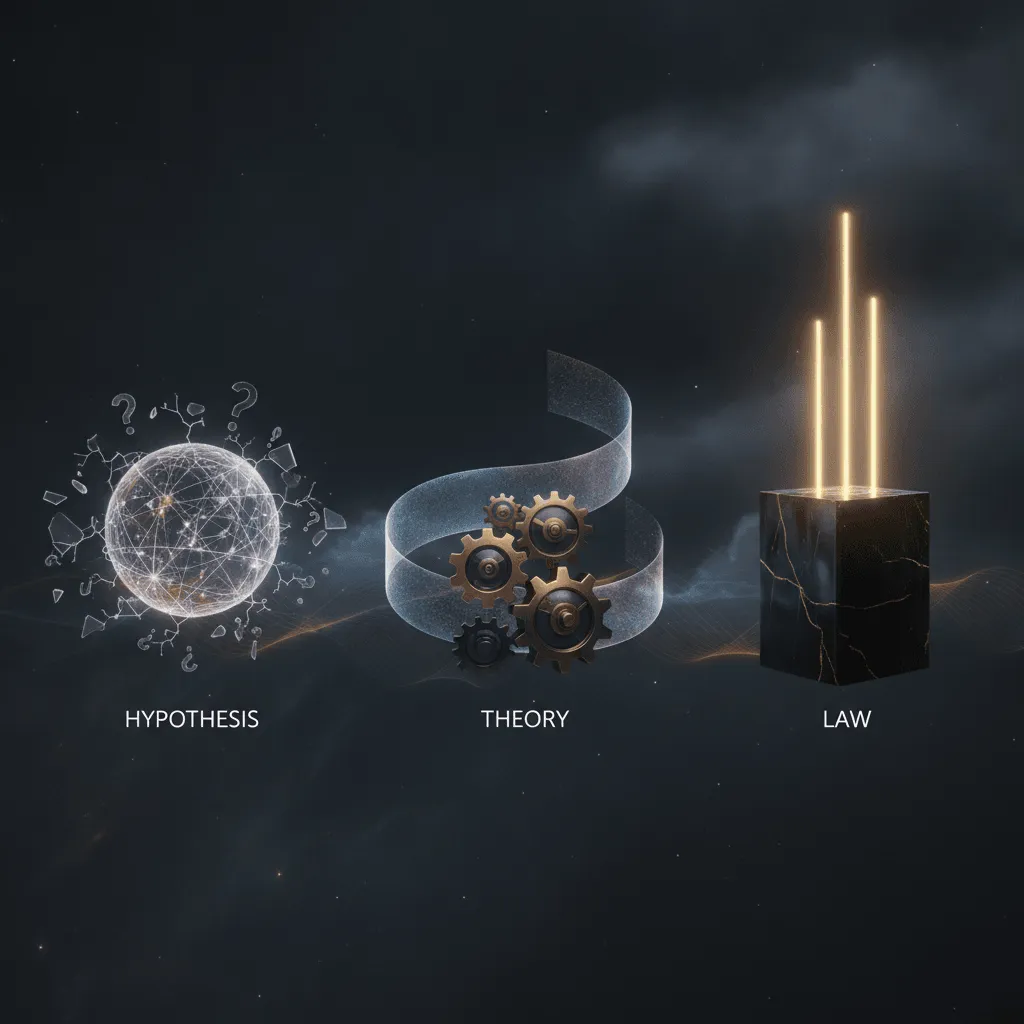
In Science, 'Theory' Is Not a Guess
In everyday speech, "theory" often means a guess or a hunch. In science, the word has a different, far more rigorous meaning. A scientific theory is a well-substantiated explanation of some aspect of the natural world, based on a body of facts that have been repeatedly confirmed through observation and experimentation. Such a theory is not a guess. It is a reliable account of how a part of the world works. In fact, a scientific theory represents the highest level of certainty that science can offer.
Familiar examples include the theory of evolution, the atomic theory of matter, and the germ theory of disease. Each of these theories accounts for a wide range of phenomena and rests on evidence gathered from many independent lines of investigation.
The gap between the everyday and the scientific meaning causes real confusion. When someone says "it's just a theory," they imply the idea is unproven and tentative. But in science, that phrase misrepresents what a theory is. A theory is the opposite of an untested idea. It is an explanation that has survived repeated testing and competing explanations. Calling a scientific theory "just a theory" misrepresents its reliability.
Hypothesis vs. Theory: Testable Prediction vs. Comprehensive Explanation
To understand why a theory is so well-supported, it helps to compare it with a hypothesis. A hypothesis is a testable prediction or proposed explanation based on limited evidence. It is very tentative and can be easily changed. For example, a scientist might hypothesize that plants grow faster when exposed to more sunlight. That statement can be tested with a controlled experiment.
Hypotheses are narrow. They usually address one variable or relationship at a time. After many such hypotheses are tested and confirmed, they can be "piled on top of each other" to form a theory. A theory thus develops after multiple hypotheses are supported by evidence and integrates many experimental results into a comprehensive explanation.
Consider how a scientist studies plant growth. She might begin with a hypothesis about light. Then she tests related hypotheses about water, soil nutrients, and temperature. Supported results from many experiments can eventually be combined into a broader theory of how plants grow. The theory explains all those experimental results with a few underlying principles.
Whereas a hypothesis is an early-stage idea, a theory is an advanced, highly reliable explanation. The difference is not just a matter of how many tests have passed. A theory is a broader and more integrated kind of knowledge. It connects many findings into a single framework.
When you encounter science news, keep these terms distinct. A headline about a "new hypothesis" describes something researchers are still testing. A "theory" has been confirmed through many tests and is widely accepted. This distinction is also why "hypothesis vs theory" is not a battle between stronger and weaker ideas; they are different tools for different purposes.
Scientific Laws: Different in Scope, Not in Certainty
Scientific laws and theories are both well-supported explanations, but they serve different purposes. The difference is breadth, not certainty. Hypotheses, theories, and laws are all scientific explanations. They differ in how broad a range of phenomena they cover. Theories apply to a broader range of phenomena. Laws are narrower in scope.
Take the law of gravity. It describes a consistent relationship between masses. It does not explain why that relationship holds; that task belongs to theories. Both the law and the theory are reliable. They just answer different questions.
The popular idea that a hypothesis becomes a theory and then a law is misleading. These terms describe distinct scientific concepts, not stages in a linear progression. A law is not a theory that has been "proven more." A theory is not a hypothesis that "graduated."
In science, neither "theory" nor "law" is a synonym for an untested idea. Both are the products of rigorous testing. When a science report uses the word "law," it refers to a well-established pattern, not a suggestion. And when it uses "theory," it refers to a comprehensive explanation, not a guess.
So the next time you see a headline about a "theory," resist the urge to dismiss it. The word carries far more weight in science than in everyday conversation. Understanding the terms helps you read research and news with the right expectations.