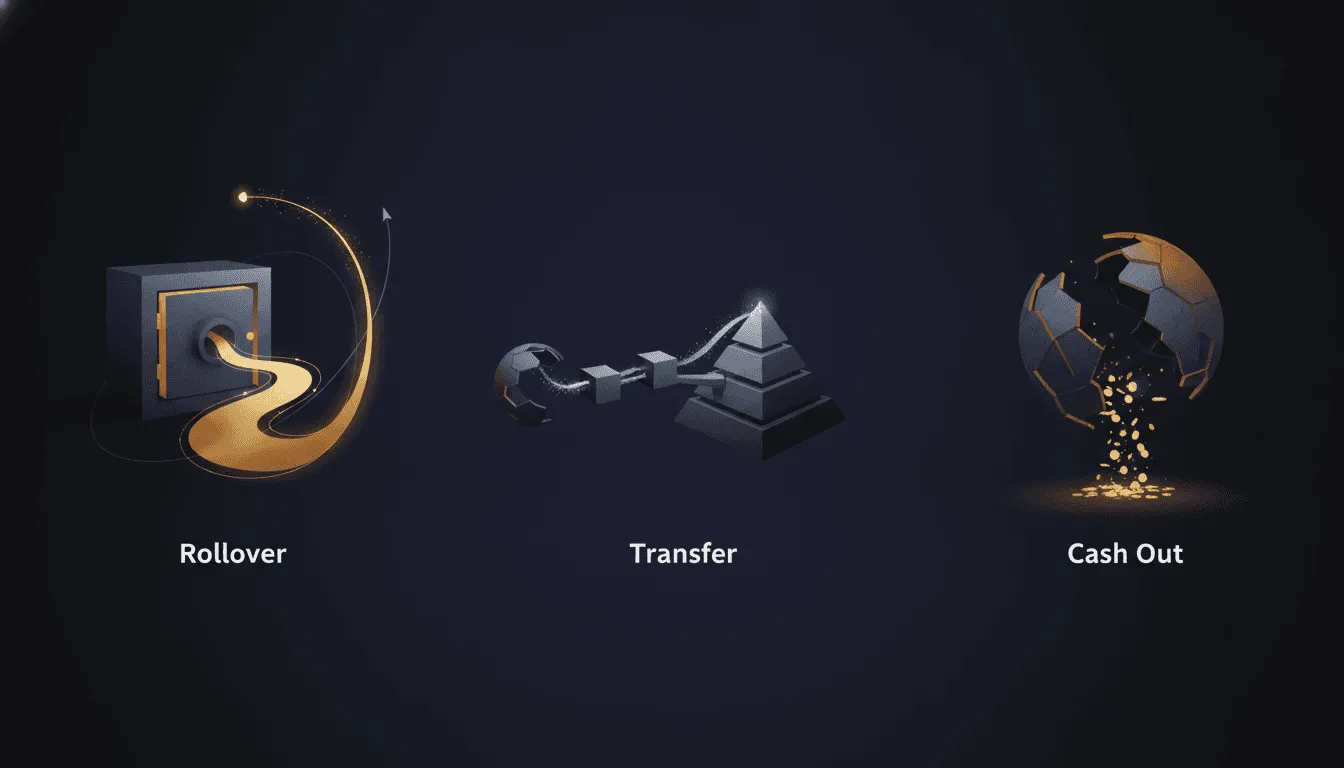
Leaving a job does not force you to move the 401(k) you built there. You generally have four options: leave the balance in the former employer's plan, roll it to a new employer's plan, roll it to an IRA, or cash it out. Three of those keep the money inside a tax-advantaged account. Cashing out is the outlier, because it creates an immediate tax event.
Balance size can eliminate choices before you weigh anything else. If the balance is under $5,000, an employer may require you to move it out of the plan. Under $1,000, the former employer will likely cut you a check, and that check must reach a new plan or an IRA within 60 days to avoid taxes and early-withdrawal penalties. The smaller the balance, the more likely the plan will push it out.
Sort the remaining choices with one set of filters: the tax status of the money, the fees each account charges, the investment options each offers, and the size of the balance. Before-tax and Roth dollars do not travel the same way, so an account holding both needs a plan for each. Fees and fund menus differ across the old plan, the new plan, and an IRA. Before-tax dollars are taxed when you withdraw them in retirement, while Roth dollars were already taxed on the way in. A plan that charges departed workers more, or limits them to a narrower fund menu, changes the math against leaving the balance where it sits.
Keeping the balance in the former employer's plan works only if the plan permits it. When it does, the money keeps growing tax-advantaged and you avoid a move. Check the plan's minimum-balance rules, administrative fees, investment options, and provisions for former employees. A plan that allows former employees to stay may still charge them more than active workers.
Rolling into a new employer's plan preserves the tax advantage and consolidates accounts onto one statement. Confirm that the new plan accepts rollovers, whether a waiting period applies before you can enroll, and whether it can hold Roth assets. A plan that takes only before-tax money will not accept a Roth 401(k) balance. Compare its investment options and fees against the old plan before you commit.
An IRA rollover keeps the account tax-advantaged and typically widens the investment menu beyond what either employer plan offers, along with more flexibility in how you manage it. Before-tax assets go to a Traditional IRA; Roth assets can go directly to a Roth IRA. Compare IRA investment options and fees against both employer plans before assuming the IRA is the cheaper home. An IRA also stays with you across future job changes, while an employer plan balance does not.
Rolling before-tax money into a Roth IRA is a separate transaction. The untaxed amount becomes part of your gross income for the year of the rollover, so the conversion carries a tax bill in that year, even though the destination is a retirement account.
Two traps sit inside the rollover decision. Employer matching funds may be only partly vested, which means you could keep less than the full match if you leave. And if the account holds employer stock, rolling it can forfeit access to net unrealized appreciation tax treatment, a break that is gone once the move is made.
Cashing out carries the widest immediate cost. The distribution is generally taxable income, tax withholding applies at the time of payment, and a 10% early-withdrawal penalty can apply if you are under age 59½. Because the plan withholds at the time of payment, the check you receive is smaller than the balance, while the full amount still counts as income. The IRS also describes an additional early distribution tax when you are not at least age 55, or age 59½ for a SEP or SIMPLE IRA plan, and a 25% additional tax on SIMPLE IRA withdrawals made within two years of first participating in the plan.
A quieter cost is what the account stops doing. Money pulled out of a tax-advantaged account no longer grows on a tax-deferred basis, and that foregone growth never comes back. If a short-term expense is driving the decision, an emergency fund is the cleaner source of cash, and you can read more about sizing one in Emergency Funds: Your Financial Safety Net.
Moving the money without a tax bill starts with a direct transfer. The old plan's trustee sends the balance straight to the new plan or IRA, so you never take possession of the funds. Because the money moves trustee to trustee, it never counts as a distribution, so no withholding is triggered and the 60-day clock never starts. Request the transfer in writing and follow up until the receiving account confirms the deposit.
An indirect rollover works differently. If the old plan pays the balance to you, it usually withholds 20% for federal income taxes. You then have 60 days to deposit the funds into a new plan or IRA and to replace the withheld 20% from other money. Deposit only what you received, and the withheld amount is treated as a distribution: you include it in gross income and may owe an additional early-distribution tax. The mistakes that cause most of the damage follow from those mechanics: forgetting an old account leaves it sitting in a plan you no longer monitor, missing the 60-day window turns the full balance into a taxable distribution, and treating a check made out to you as tax-free ignores both the withholding already taken and the income it creates.
Confirm the plan's procedures before you start, since some plans require specific forms. This is general educational information, not individually tailored financial advice.