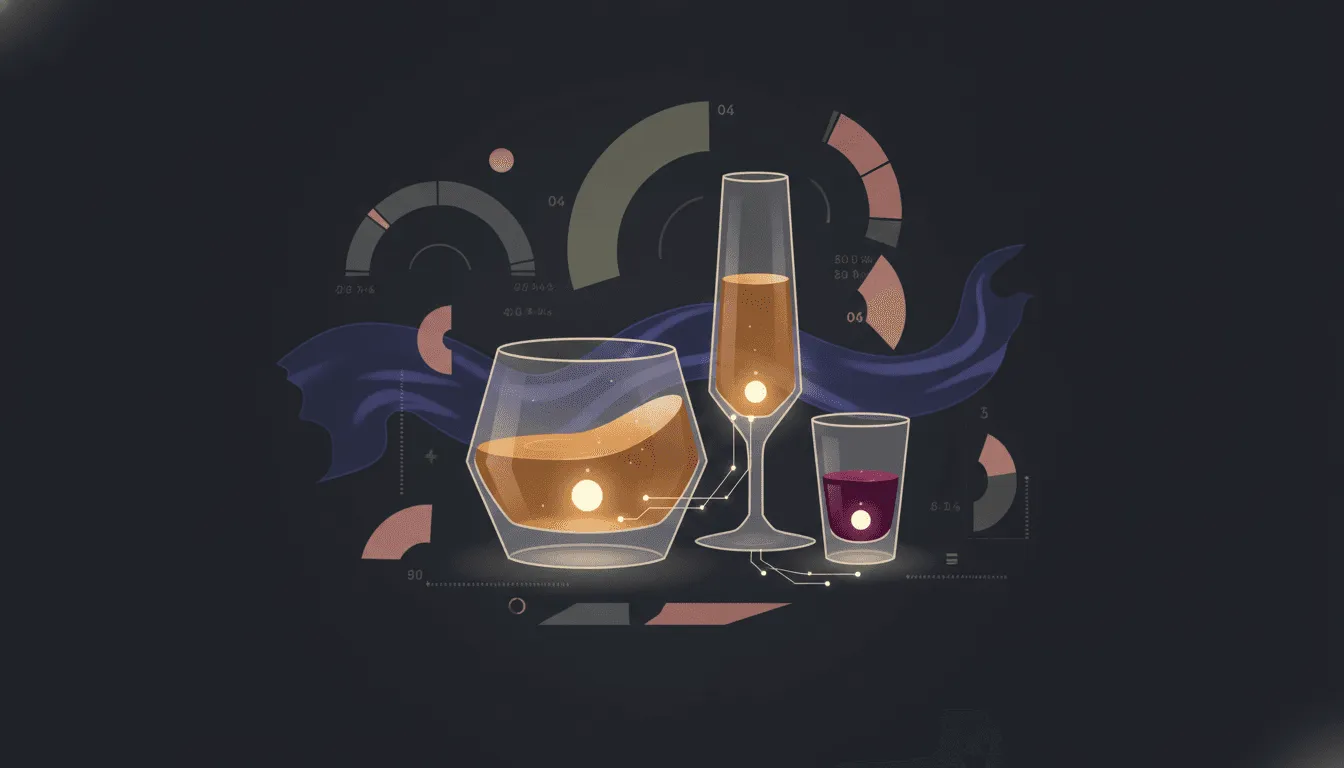
A standard drink measures alcohol, not liquid. In the United States, one standard drink contains about 14 grams, or 0.6 fluid ounces, of pure alcohol. The figure describes the alcohol itself, so it holds constant regardless of what the alcohol is mixed with or how large the glass is.
The measure exists so that beer, wine, and spirits can be compared on a single scale. It does not describe the serving size a bar, restaurant, or bottle label prints, which can be larger or smaller than a standard drink.
The National Institute on Alcohol Abuse and Alcoholism illustrates the quantity with three familiar pours: 12 fluid ounces of regular beer at 5% alcohol by volume (ABV), 5 fluid ounces of table wine at 12% ABV, or 1.5 fluid ounces of distilled spirits at 40% ABV. The volumes differ roughly sevenfold; the alcohol delivered is the same.
ABV is the share of a liquid's volume made up of ethanol. It is the number that connects a pour's size to its alcohol content, and it appears on most containers.
The phrase "standard drink" is not universal. Other guidance defines a standard drink as 10 grams of alcohol, roughly a 330 ml can of 5% beer, a 100 ml half glass of 15% wine, or a 30 ml shot of 40% spirits. A country using the 10-gram definition counts a smaller drink than the U.S. 14-gram definition does. Before you compare your intake with any limit, identify which definition that limit uses.
Guidance lists further equivalents at the U.S. standard: 8 to 10 fluid ounces of malt liquor or flavored malt beverages such as hard seltzer at about 7% ABV, 3 to 4 fluid ounces of fortified wine at about 17%, 2 to 3 fluid ounces of cordial, liqueur, or aperitif at about 24%, and 1.5 fluid ounces of brandy or cognac at about 40%. Each is a different size and the same amount of alcohol.
The multiplier does the work. A 12-ounce beer at 5% ABV contains one standard drink. The same 12 ounces at 10% ABV contains two. Nothing about the bottle changed; the concentration doubled.
Category names hide that variation. Regular beer may be 5% ABV, some light beers 4.2%, and some craft beers 10%. Many light beers also carry almost as much alcohol as regular beer, about 85% as much, so a "light" label signals fewer calories and a lighter body more reliably than it signals low alcohol. Reading your own intake takes both inputs: the volume poured and the ABV on the label. That habit is the same one behind reading the numbers on a nutrition label, applied to a different fluid.
Guideline units assume measured pours. Household practice drifts above them. A home wine pour may ride past the 5-ounce line, a craft IPA may be nearly double the strength the "one beer" math assumes, and a generously poured cocktail may hold two or three standard drinks in one glass. Craft beer, a generous wine pour, or a mixed drink commonly counts as 1.5 to 3 standard drinks.
That gap between the standard unit and the actual pour is described as the single biggest reason people underestimate how much they drink.
Glassware sets part of the ceiling. A large wine glass filled to a typical level holds more than the 5-ounce standard assumes, which is where the visual estimation tricks used for food portions transfer to pouring. In a mixed drink, each spirit portion adds another 1.5-ounce shot's worth, so a recipe with two spirits starts at roughly two standard drinks before mixers are added.
Bottles hide the count too. A 750 ml bottle of 12% wine holds about five standard drinks. Splitting it between two people is closer to two and a half drinks each than to one.
Federal daily and weekly limits are counted in standard drinks, which makes the arithmetic a measurement tool rather than a verdict. Converting your pours into those units is what makes any comparison possible.
The comparison has a reason behind it. Recent evidence finds no level of alcohol consumption that is fully risk-free. One public health source states there is no safe amount of alcohol that does not affect health; for people who do drink, it lists limits of no more than two standard drinks per day for men and one for women, and it defines binge drinking as 5 or more standard drinks for males or 4 or more for females on one occasion. Those thresholds are written in standard drinks, so a cocktail that counts as three moves you toward them faster than the size of the glass suggests.
Implementation is one calculation, repeated per drink type. Pick a drink you pour at home. Note two numbers: the volume you actually pour and the ABV on the label. Multiply volume by ABV to get the alcohol content, then divide by 0.6 fluid ounces, the size of one U.S. standard drink. A 6-ounce pour of 13% wine works out to about 1.3 standard drinks. A 16-ounce craft beer at 8% comes to about 2.1. Run the calculation once for each recurring pour and the estimates become figures you can reuse.