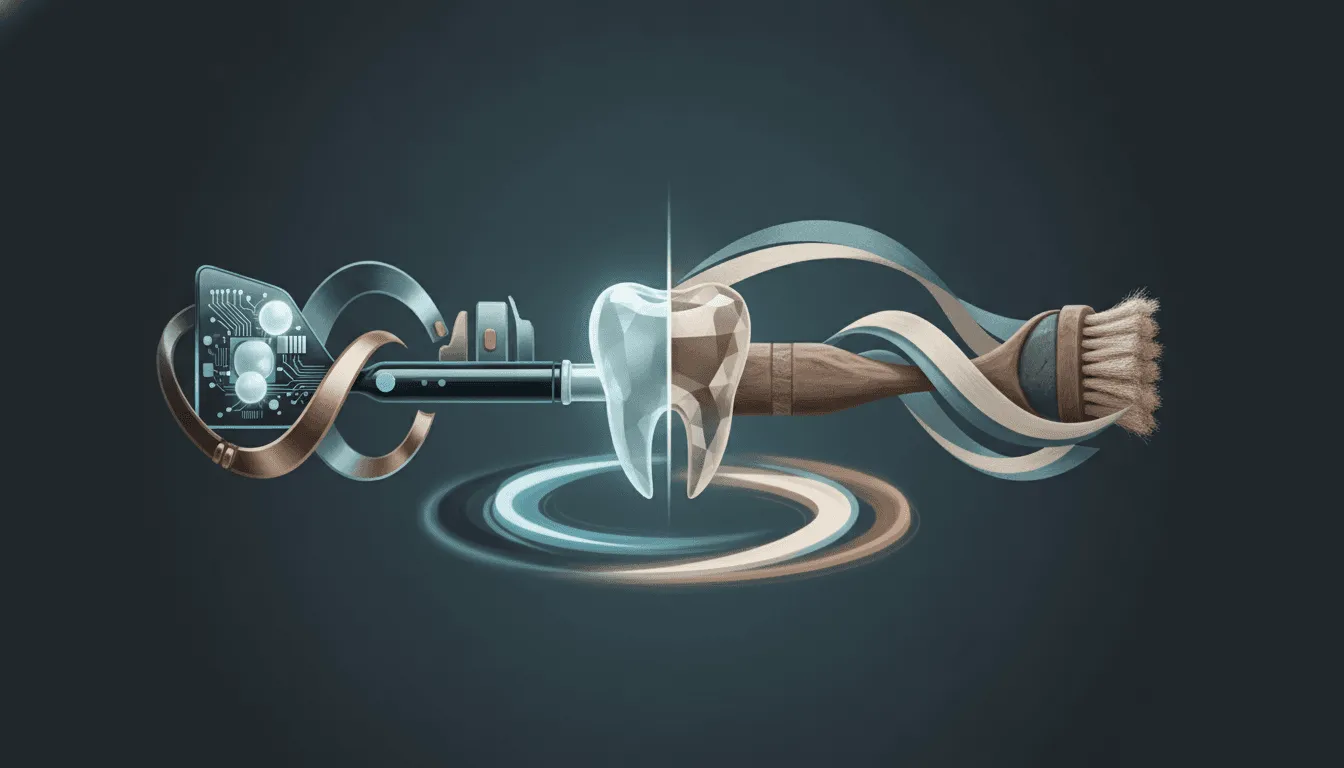
Plaque removal depends first on how you brush, not on what powers the bristles. A good-quality manual toothbrush with soft to medium bristles removes plaque effectively when the angle, duration, and coverage are right. For someone with solid technique who brushes a full two minutes twice a day, a manual brush is adequate on its own. Soft to medium is the standard recommendation for bristle firmness.
The gap most people have is routine, not hardware. Studies show many people do not brush for the recommended duration or apply optimal technique consistently, which makes the limits of a manual brush more visible, especially for people prone to plaque build-up or early-stage gum disease. One source estimates that the average person removes only about 50% of plaque during brushing. That estimate signals incomplete plaque removal, but it does not by itself establish whether duration, angle, coverage, or another factor is responsible.
Plaque is a soft film that forms on teeth and along the gum margin. It builds up in the places a brush reaches last: the back molars, the inner faces of the front teeth, and the narrow band just under the gum. Missing those areas leaves deposits that a longer session elsewhere cannot make up for, which is why coverage matters as much as duration.
A manual brush asks you to manage the angle, the stroke, and the pressure at once. Angle the bristles toward the gumline and use short strokes so the tips travel along the edge where the tooth meets the gum. Move around the mouth in a fixed order so the outer, inner, and chewing surfaces of each tooth get the same attention. Use light pressure, and let the bristle tips do the work along the gumline. A manual brush leaves the pacing and the pressure to you, with no timer or pressure cue built in.
An electric toothbrush supplies the brushing motion itself. You guide the head along the surfaces of your teeth and let the brush do the moving; one manufacturer describes it as guiding the brush while it handles roughly 90% of the work. A small round head on an oscillating-rotating model cups each tooth and works back and forth across the surface it touches, so the motion holds steady while your hand only steers.
Clinical evidence generally suggests that powered brushes, particularly those with oscillating-rotating heads, may be more effective than manual brushes at reducing plaque and gingivitis over time. Gingivitis is inflammation of the gums, and plaque that sits along the gumline feeds it. The difference is measured over time, not in a single brushing. That is a tendency across studies, not a guarantee for every user. Someone who already brushes well may notice little difference between the two. The benefit shows up most in people whose technique slips, because the brush keeps its motion steady even when your hand slows or wanders.
Features are where a powered brush earns more of its price. Built-in timers remove the guesswork for anyone who tends to stop early. Pressure sensors flag when you push too hard, giving a cue to ease off before a firm scrub becomes a habit. Selectable brushing modes let you match the head speed to your needs. For people with dexterity challenges such as arthritis or disabilities, a powered brush can be easier and less painful to use. Powered brushes may also help children brush more effectively, though age recommendations should be checked before buying.
A worn brush cleans less effectively than a fresh one, so replace it on a regular schedule. A manual brush is replaced whole; a powered one takes a new head on the same handpiece.
The trade-offs run in both directions. Manual brushes win on simplicity: no charging, inexpensive replacement, and easy travel. A powered brush runs on a charged battery, but it needs only a head change, which keeps the handpiece in use and reduces what gets thrown away over time.
How the cost works out depends on the model. A manual brush is bought whole, handle and bristles together. Many powered brushes separate the two, so the recurring purchase is a small head rather than a new handle, and how much that saves depends on the head price and how long each one lasts. Models differ: some run on rechargeable batteries, others on disposable ones, and head prices vary.
Which type suits you depends on your oral health, dexterity, and brushing habits. A personal history of plaque build-up or early-stage gum disease is one reason to look at a powered brush, and so is limited hand mobility or grip strength. A dentist or hygienist can match the tool to your situation rather than to its price.
Each feature answers a specific habit. A timer answers the person who stops early; a pressure sensor answers the person who scrubs; a lighter head and steadier motion answer the person whose hands tire. A feature you do not need is one you pay for without using.
If you brush gently for two full minutes, twice a day, and reach every surface, the motor adds little. If you know you rush or find a manual brush hard to hold, the timer and pressure sensor a powered model brings do work your hands currently are not doing. The tool is only part of the routine either way; what matters most is using it correctly and consistently.