Why Noise Damage Is Permanent and Quietly Cumulative
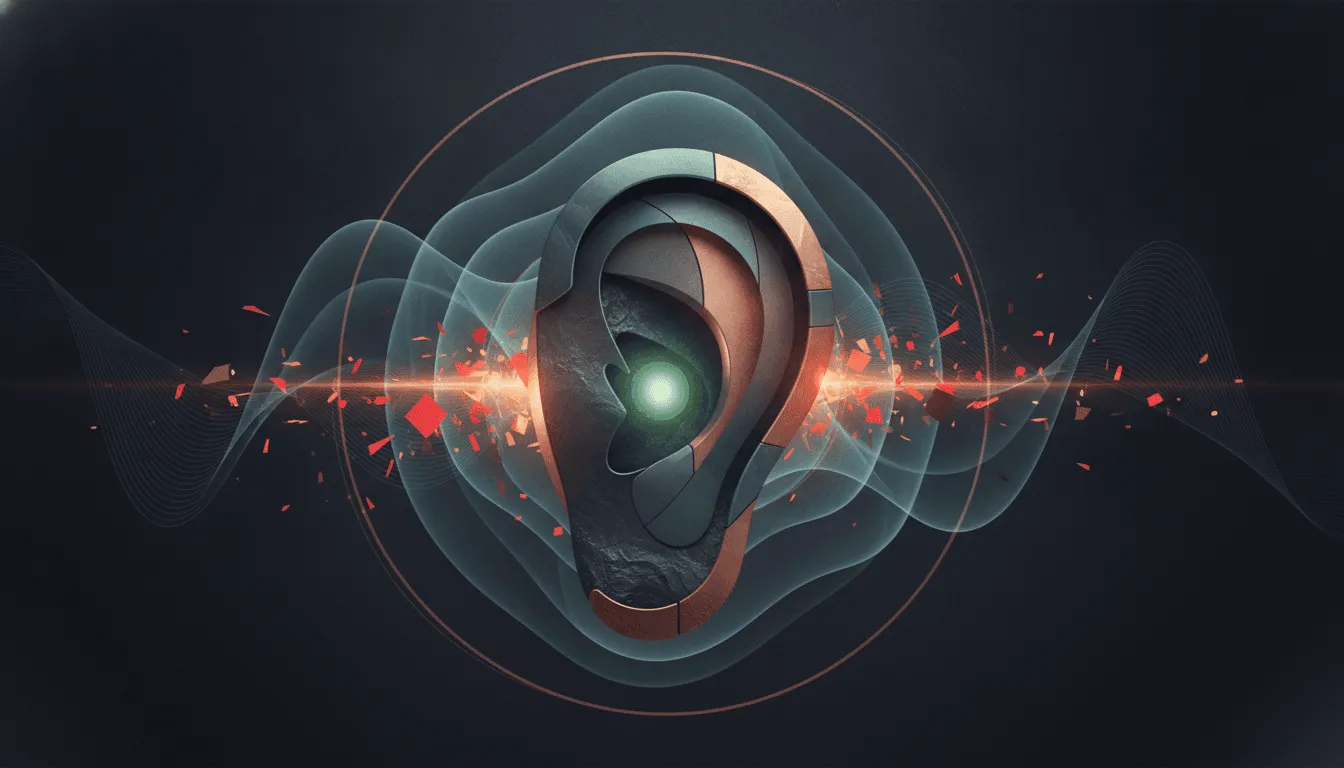
The hair cells in your inner ear cannot repair themselves. Damage from loud sound is therefore permanent, and it builds without any signal that something is wrong. Most people notice noise-induced hearing loss only after it has been accumulating for years.
What drives that accumulation is total daily dose, not one event. Noise fatigue describes what happens when moderate sound is sustained across a whole day: the commute, the meetings, the social plans layered on top of one another. The ear ends the day tired even when no single moment felt loud. Sustained sound fatigues the sensory cells, which is why a long day of moderate noise can leave hearing dulled and ringing even though nothing ever seemed loud enough to hurt.
A reliable test takes one second. If you have to raise your voice to be understood by someone standing next to you, you are already in the danger zone.
The ceiling arrives faster than most people expect. You can lose some hearing in a few minutes of headphone use at maximum volume, and after about an hour on a motorcycle. Volume, duration, and how often exposure repeats set the risk. Repeat exposure is what turns temporary fatigue into permanent loss.
Decibels, Duration, and the 60/60 Rule
Safety guidance puts the daily limit at 85 decibels for eight hours. The trade-off between loudness and time is steep and runs in both directions. At 80 decibels you can listen safely for up to 40 hours in a week. At 90 decibels, that window shrinks to about four hours a week.
The math is logarithmic: every 3-decibel increase doubles the sound energy, which cuts safe listening time in half. Small volume reductions therefore buy large amounts of extra time. Dropping a few notches rarely sounds like much in the moment and changes the arithmetic substantially.
Headphones make this harder to judge, because sound is delivered straight into the ear canal and the outside world gives you no cue that it is loud.
A commonly cited shorthand, the 60/60 rule, pairs two habits. The World Health Organization recommends keeping headphone volume at or below 60 percent of a device's maximum. The second half of the pair, a break after about 60 minutes of continuous listening, is common guidance rather than a WHO figure. Music stays enjoyable at 60 percent.
A volume limit set once in your phone's settings caps the maximum output, so the ceiling holds even when you are not thinking about it.
Because the daily total is what counts, the same number of waking hours can be safe or damaging depending on what fills them. A quiet office day leaves room for a loud evening. A noisy commute stacked on a loud gym session draws from the same ledger, and the ear has no way to distinguish work noise from recreation.
Earplugs: Foam, High-Fidelity, and How to Wear Them
Foam earplugs block the most sound for the least money, and they suit yard work or a loud commute. They also muffle unevenly, flattening music and speech into a dull blur. High-fidelity plugs, often sold as musician's plugs, lower volume more evenly across frequencies, so a concert still sounds like a concert. For most concerts and sporting events, that trade is worth the higher price.
Timing matters as much as the plug. Keep a pair in a small case on your keychain and put them in just before you walk into a noisy venue. Waiting until your ears are already ringing means the exposure has happened.
Fit does a lot of the work. A plug resting loosely at the entrance of the canal blocks far less than one seated properly, which is part of why two people at the same show can leave with different outcomes. The seal, not the plug itself, is what holds the sound out.
Match protection to the setting. At a sports game, some hearing can be lost in under half an hour, so plugs are not overkill. In a movie theater, sit farther from the speakers and bring plugs for the loudest sequences. For lawn mowing, wear hearing protection such as earmuffs. The CDC advises turning the volume down, moving away from the loud source, taking breaks, and using hearing protection.
Warning Signs and When to Get Your Hearing Tested
Signs worth acting on: persistent ringing in the ear, known as tinnitus; difficulty hearing high-pitched sounds or following a conversation in a group; muffled hearing or a feeling of pressure in the ear canal; and a habit of turning the volume up because everything sounds quieter than it used to.
Ringing right after headphone use means the auditory system was overloaded. A single episode may settle on its own. Recurring ringing, ringing in only one ear, or muffled hearing that lingers warrants a check rather than a wait. Symptoms can also show up unevenly, as trouble picking one voice out of background noise while quiet rooms still sound fine.
Get a baseline test early, before starting noisy work or a loud regular hobby if you can, then repeat it on whatever schedule your clinician advises, and sooner if symptoms appear. Testing fits alongside the rest of your health screening checklist, though the ear exam is rarely the one people book first. How often to retest is a clinical judgment, not a fixed number. Ask your audiologist or physician what interval fits your exposures, and shorten it if you notice a symptom between visits.
The value of a baseline test is the reference point it creates. A change shows up against that point while preventive habits still have room to work.