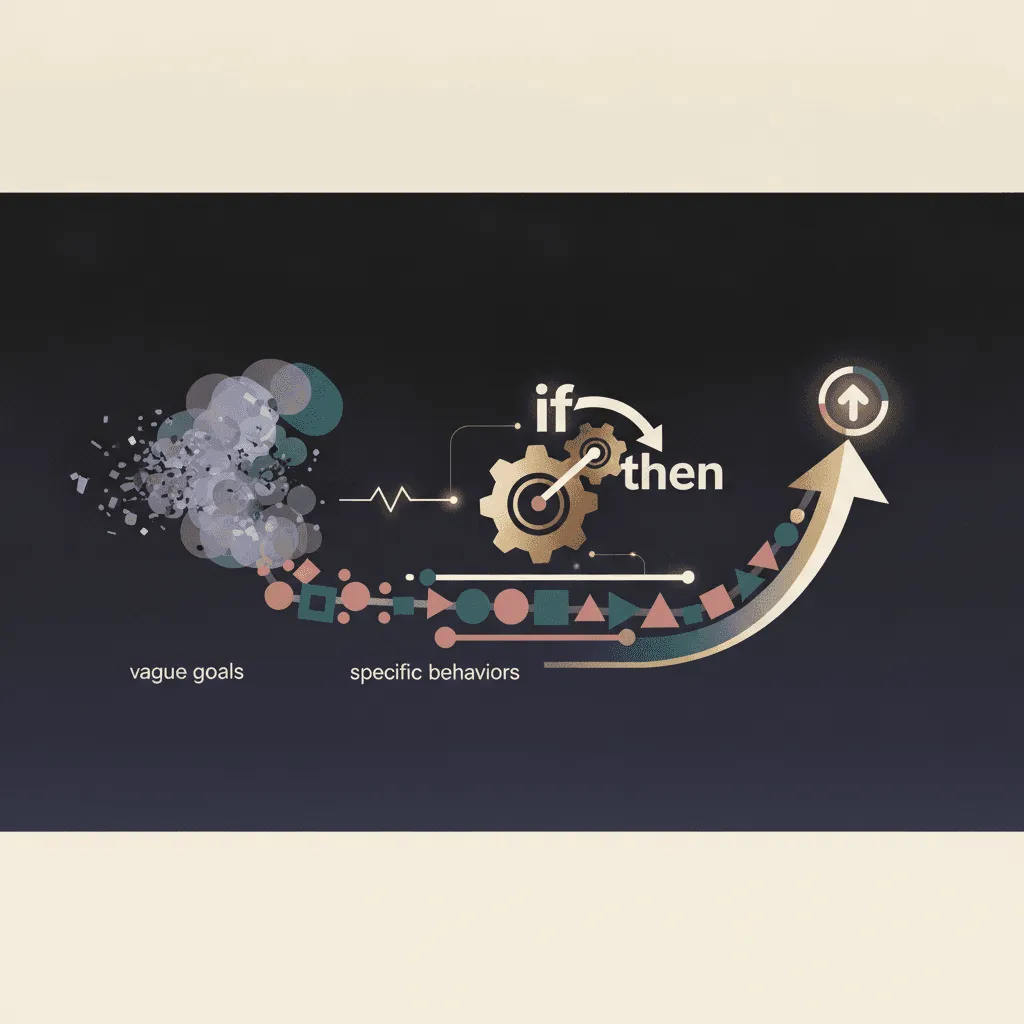
You open your laptop to draft the quarterly report, but after two hours of answering emails, checking the news, and tidying your desk, the document is still blank. This gap between intention and action is often due to a lack of a concrete plan. Distractions compound the problem—knowledge workers lose an average of 2.5 hours per day to interruptions, and over 82% of employees are now at risk of burnout, signaling that our current approaches are unsustainable. Implementation intentions offer a practical solution: simple if-then plans that link a specific situation with a specific behavior. For example, "If it is 10 AM, then I will begin my focused work session." By deciding in advance what to do when a cue occurs, you reduce hesitation and make it easier to start the task. This lean planning technique aligns with sustainable productivity principles: protecting focus time and conserving mental energy by removing the need to deliberate at the moment of action.
An implementation intention follows a simple but powerful structure: "If [situation], then [behavior]." The key is specificity. Instead of a vague goal like "work more," you define exactly when, where, and how you will act. The cue can be a time, a location, an emotional state, or a preceding event. Common work examples: "If I finish reading my morning emails, then I will review my daily priorities," or "If I feel distracted by notifications, then I will switch my phone to silent mode." This structure contrasts sharply with general intentions that leave crucial details undefined. By pre-deciding your response, you avoid having to decide what to do in the moment. The cue itself becomes a prompt that automatically initiates the behavior, much like a well-worn habit. For workplace scenarios, time-based cues are especially effective: "If the clock strikes 10 AM, then I start my deep work block." Or you can use emotional states: "If I feel anxious about a deadline, then I will break the task into three smaller steps and start the first one." The more specific the cue and the action, the easier it is to follow through.
The power of if-then plans lies in their ability to create a clear link between a cue and an action. When you repeat your plan consistently, the response starts to become automatic—like a habit you've built. This automaticity is valuable for sustainable productivity because it frees your mental energy for the work itself. By planning your actions in advance, you reduce the hesitation that can waste precious focus time. In fact, protecting even one daily deep-work block can significantly improve your output and reduce stress. Aligning your if-then plans with your natural energy cycles—using your high-focus hours for your most important cues—further boosts their effectiveness. This approach supports the sustainable productivity rhythm of working smarter: focusing your best energy on the tasks that matter most, with minimal decision-making overhead.
To put implementation intentions into practice, start by identifying your most common sticking points: when do you usually procrastinate or lose focus? Then craft a specific if-then plan. For example, "If I finish my morning coffee, then I will write my top three priorities." This ties the new behavior to an existing routine, which increases reliability. Another common scenario: "If I feel the urge to check social media, then I will take three deep breaths and return to my task." Be as precise as possible about the cue and action. Begin with just one or two plans to avoid overwhelm, then gradually expand to cover more situations. You can also combine if-then plans with micro-boundaries, such as "If I start a focused task, then I silence my phone and close my email." These small boundaries compound into big results. For transitioning between activities, use a plan like "If I finish a meeting, then I will write down one key takeaway before closing my notebook." The key is consistency: over time, these if-then plans become habitual, turning your intentions into consistent actions without requiring constant reminders. This approach works hand-in-hand with energy management: reserve your most critical if-then plans for your peak performance hours, matching your chronotype. Whether you already use time blocking or the Getting Things Done method, adding if-then plans can strengthen the execution of your daily routines, ensuring that good intentions translate into real outcomes with minimal effort.