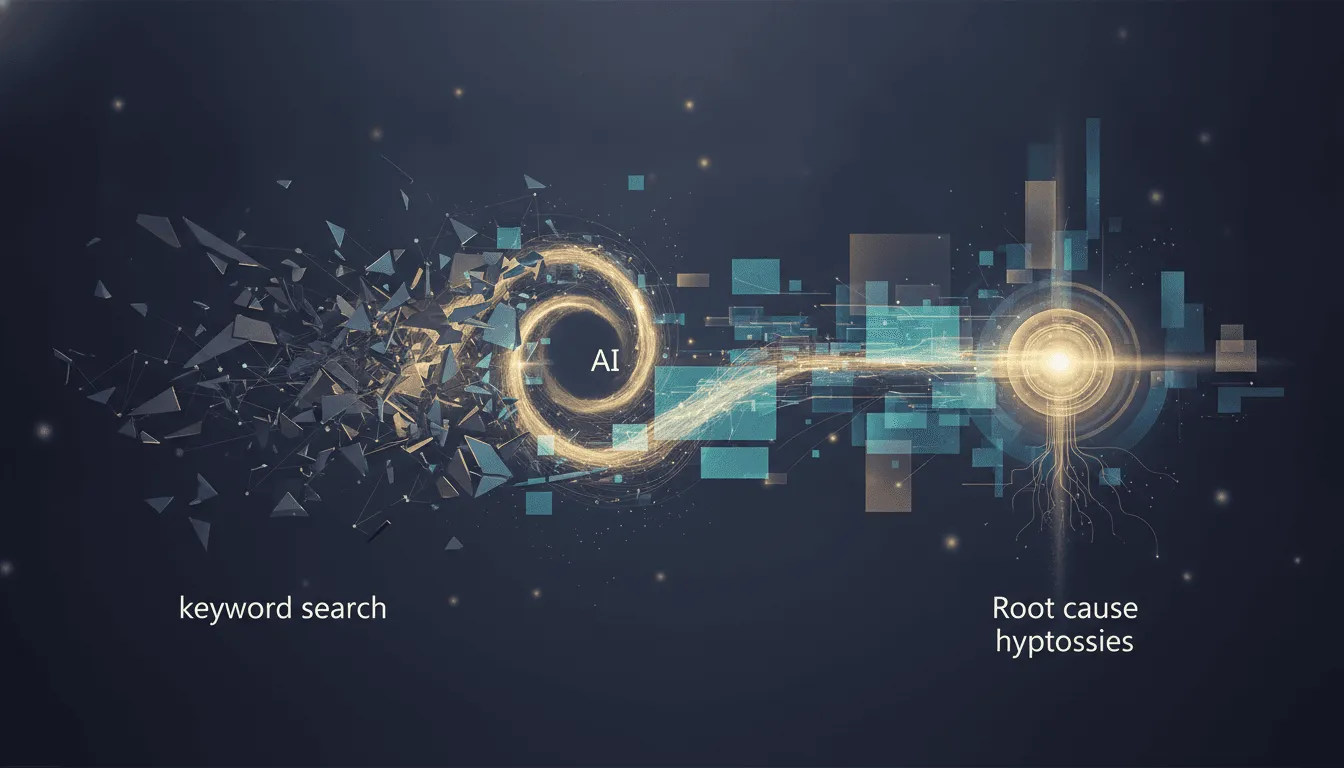
Product teams now manage more open-ended feedback than ever—from surveys, support tickets, and interview transcripts. Manually synthesizing thousands of responses to uncover recurring themes is time-consuming and often inconsistent. AI can accelerate this process, but as Knight Columbia researchers argue, AI is best viewed as a normal technology: a tool that remains under human control, not an autonomous agent. The 2026 shift toward pragmatic AI deployment, noted by TechCrunch, makes smaller, task-specific models increasingly viable for feedback analysis. However, without careful process design, automated analysis risks introducing bias and flattening the nuance that makes qualitative research insightful. Unlike structured requirements engineering, user feedback synthesis involves messy, open-ended data where context matters. Analysts must treat AI as an amplifier of their capabilities—a view supported by ThoughtWorks—and design the process to preserve context, allow human oversight, and guard against over-reliance that could erode competence over time, as some discussions on Reddit have warned.
Effective preprocessing is critical to reduce noise and improve accuracy. This includes cleaning text—removing irrelevant characters, normalizing spelling, tokenizing, and addressing language variations—tailored to the feedback source. Support tickets may contain technical jargon and abbreviations, while survey responses often have informal language, emojis, and typos. Each step must be carefully applied to avoid stripping meaningful signals. For instance, standardizing common product terms across responses can help the model recognize patterns more consistently.
The choice of NLP model depends on the analysis goal. Topic modeling helps identify broad themes across large corpora; sentiment analysis captures emotional tone; large language models (LLMs) provide contextual interpretation of responses. Yet the pragmatic turn in AI, highlighted by TechCrunch, favors smaller, task-specific models that are more reliable and cost-effective for targeted tasks like feedback categorization. As a Reddit discussion on AI agents points out, the single most important criterion is how well a model fits into a specific environment rather than raw capability. Evaluation on domain-specific data is essential to ensure the model understands your users’ language and context. For example, a model fine-tuned on product support tickets will outperform a general model on that domain. In line with the industry's shift toward pragmatism, many teams are now opting for fine-tuned, smaller models that require fewer resources and offer faster inference.
When user feedback arrives in multiple languages, analysts must choose between multilingual models and translation pipelines. Multilingual models can handle several languages natively but may have lower accuracy for low-resource languages. Translation pipelines allow the use of high-performing English models but introduce latency and potential loss of meaning. For domain-specific terminology—medical terms, financial jargon, product acronyms—models fine-tuned on relevant corpora are essential. Even the best-prepped model requires human review to verify it captures intended meanings, especially in technical contexts. Integrating these AI tools into existing research workflows ensures outputs are actionable and grounded in the actual research process. Human review is essential to correct misinterpretations and ensure the analysis aligns with research questions. This hybrid approach keeps the researcher in the driver’s seat, consistent with the normal technology perspective.
Visualizations such as word clouds, topic networks, and sentiment trend lines help stakeholders grasp key themes at a glance. AI can also generate natural language summaries of findings, but these outputs must be vetted for accuracy and completeness—they may miss context or overemphasize certain topics. Avoid over-quantifying qualitative data: preserving the original context and including disconfirming evidence prevents oversimplification. Dashboards should be tailored to the audience—product managers might want a high-level overview of top issues, while UX researchers need drill-down capabilities to explore emerging patterns. Analysts should also consider interactive visualizations that allow stakeholders to explore the data themselves, fostering better understanding. The goal is to make AI-derived insights accessible without losing the richness that only human interpretation can provide.
AI still struggles with sarcasm, nuanced language, and themes that have never appeared in its training data. Over-reliance on automated analysis may cause teams to miss subtle but important signals. As a Reddit discussion on experienced developers notes, using AI as a crutch can reduce professionals’ competence and creativity over time. Conflicting findings or unexpected results often require human judgment to reconcile. Emerging themes that the model wasn’t trained on need to be surfaced by analysts who read between the lines.
AI tools are powerful amplifiers of human capability, not replacements.
To avoid these pitfalls, teams should design processes that include periodic human audits and interpretive checks. The most effective approach combines AI’s scale with human insight, treating AI as an amplifier of research capabilities rather than a replacement for judgment. This aligns with the view of AI as a normal technology: a tool that enhances but does not supplant human expertise. By keeping humans in the loop and continuously validating AI outputs, organizations can benefit from faster synthesis without sacrificing the nuance that defines good user research. The normal technology framework warns against technological determinism—outcomes depend on how we shape and implement the tool, not on the tool alone.